
The Focus
From a relatively obscure funding mechanism, SPACs exploded into the general ECM consciousness in 2020. The numbers were quite extreme – US SPAC IPOs over 2020-2021 raised nearly the same amount as all capital raised in EMEA over the same period. After falling out of favour in the intervening years, 2025 and 2026 have seen somewhat of a resurgence in activity. So, what’s happening with SPACs?
The Graph
The Breakdown
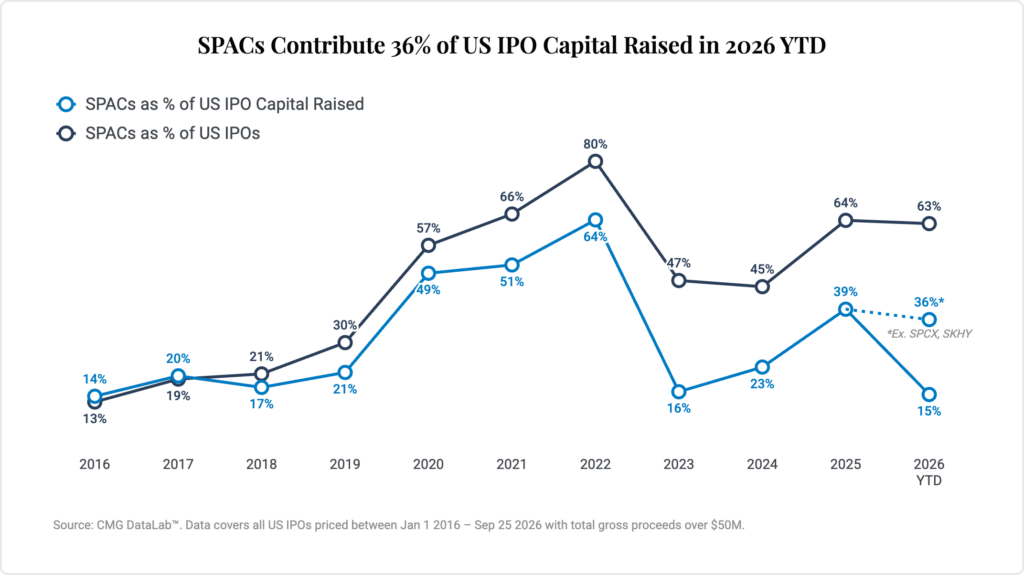
In 2021, SPAC’s accounted for 51% of all US IPO capital raised, amounting to $163B of capital funnelled into 610 acquisition vehicles. Yet it couldn’t be sustained, a saturation point was reached, too many SPACs were chasing a dwindling pool of target companies. This, combined with rising interest rates and poor post-merger performance from some of the acquisitions, led the SPAC bubble to burst.
In the intervening years, it seemed like the SPAC had been relegated back to its ECM niche but not so as proven by the $30B raised so far in 2026, making up 36% of IPO capital raised (ex. SPCX and SKHY). Partly this is linked to an upswing in the ECM market, SPACs are another way for a company to go public and if the public markets are doing well, SPACs follow.
Recent SPAC mergers have predominantly involved early stage and capital-intensive companies, with deal structures that incorporate forward-looking projections and valuations determined more in the style of an M&A transaction than an IPO bookbuild. These mergers have been concentrated in technological frontiers such as advanced nuclear, quantum computing and regenerative medicine.
The SPACs launching now also operate under much greater regulatory scrutiny than the SPACs of yore. Rules around SPAC disclosure and forecasting have been tightened and the safe harbour that protected SPACs from liability over forward-looking statements was removed by the SEC in 2024.
